A four point contact bearing is a single-row ball bearing built so each ball touches the raceway at four points instead of two. This lets one compact bearing carry axial push from both directions plus radial load, replacing what would otherwise need two separate bearings.
Shree Balaji Export manufactures and exports four point contact bearings along with other single-row and split-ring combined-load bearings to industrial buyers across Sri Lanka, South Africa, the UAE, Nigeria, Egypt, Indonesia, Thailand, and Kuwait. Each ring and ball set is gauged for correct contact angle and hardness before it leaves our facility, and our export team manages packing, paperwork, and freight so every shipment arrives complete and on schedule.
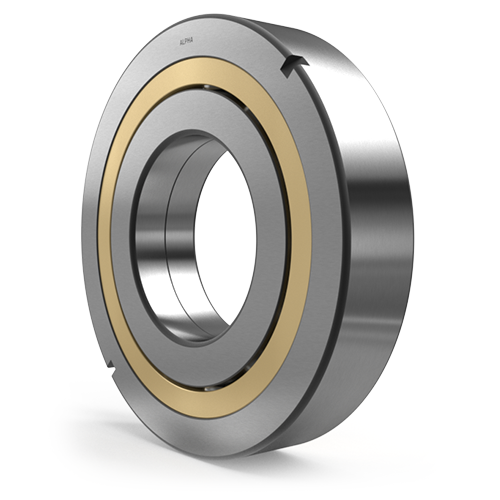
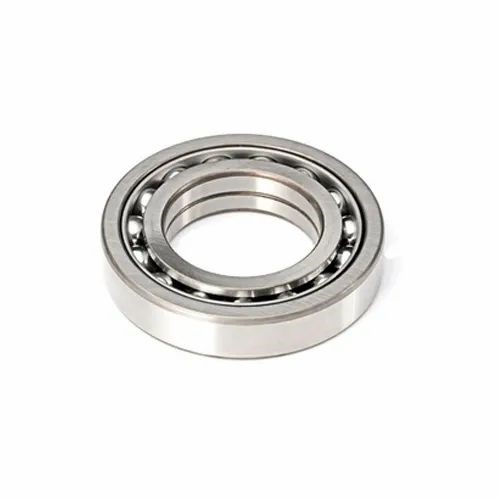
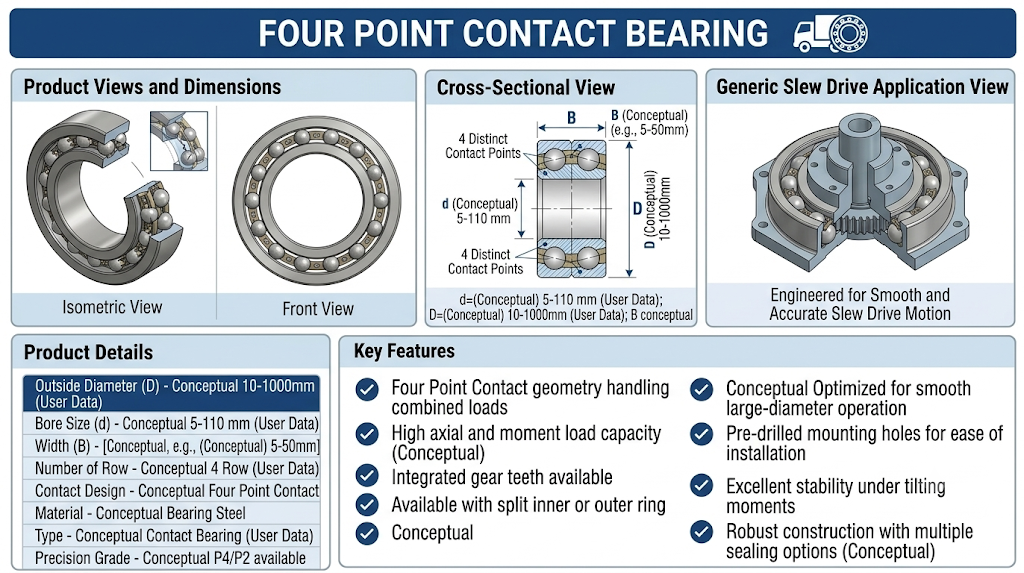
Product Specification
| Outside Diameter | 10-1000 mm |
|---|---|
| Bore Size | 5-110 mm |
| Number of Row | 4 Row |
| Type | Contact Bearing |
Understanding the Four-Point Design
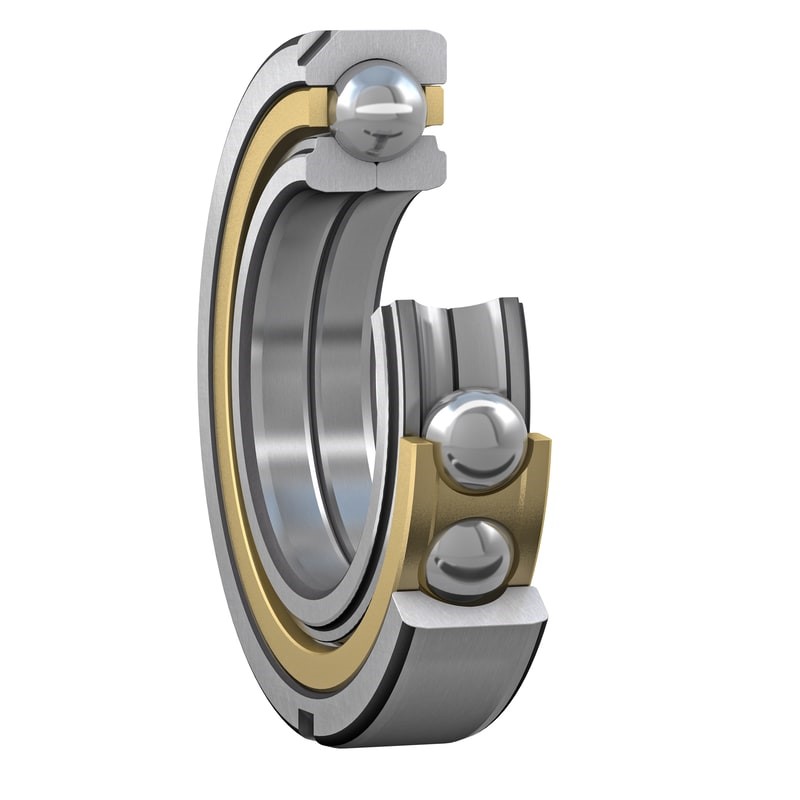
Picture a normal ball bearing: the ball sits between two raceway grooves and touches each groove at one point, giving two contact points in total. Now picture the raceway grooves reshaped so each groove is deeper and curved on both sides, more like a shallow V. In that shape, the ball touches each groove at two separate points instead of one, giving four contact points altogether — two on the inner ring and two on the outer ring.
This shape lets the same bearing resist push along the shaft from either direction, along with sideways load, all inside one slim, single-row package. Machine designers reach for this option whenever axial space is tight but the shaft still needs to be held firmly in more than one direction at once.
Split Inner Ring: A Practical Fitting TrickBecause the raceway groove is deep on both sides, sliding a full ring of balls into place during assembly is not simple. To solve this, many versions use an inner ring cut into two halves. The balls are loaded in first, and the two ring halves are then closed around them and locked together, making fitting and later removal far easier on machines that get serviced often.
Comparing It With an Angular Contact Bearing
An angular contact bearing also uses a tilted contact angle, but it usually resists axial push from only one direction well, so two of them are often paired back-to-back to cover both directions. A four point contact bearing does the same job with a single row, saving axial space and cutting the number of parts needed in the housing, though it generally carries somewhat lower load than a matched pair of angular contact units of the same size.
Common Formats You Will Come Across
- Standard One-Piece Ring Type: Used where the bearing is fitted once during original assembly and rarely removed, such as inside sealed gearboxes or machine tool spindles.
- Split Inner Ring Type: Chosen for equipment that needs regular servicing, such as compressors and pump shafts, since the split ring allows the bearing to be fitted and removed without disturbing the whole shaft assembly.
- Large-Diameter Slewing Format: Scaled up to a very large diameter and mounted with bolt holes through both rings, this format supports the full rotating body of cranes, excavators, and turntables while still using the same four-point contact idea to resist tipping load.
Sizes, Part Numbers & Where Each Four Point Contact Bearing Fits
The chart below lists common series of these combined-load bearings, along with typical dimensions and where each one is generally fitted. Send us your shaft size and expected load direction for a confirmed match.
| Part Number | Bore (mm) | Outer Dia. (mm) | Height (mm) | Bearing Type | Typical Application |
|---|---|---|---|---|---|
| QJ 208 | 40 | 80 | 18 | Single-Row Ball Bearing, X-Type Contact | Machine tool spindle, mixed load axis |
| QJ 215 | 75 | 130 | 25 | Single-Row Ball Bearing, X-Type Contact | Rotary table drive shaft |
| S-QJ 305 | 25 | 62 | 17 | Split Inner Ring Ball Bearing | Compressor crankshaft, easy assembly |
| S-QJ 412 | 60 | 150 | 35 | Split Inner Ring Ball Bearing | Large pump shaft, quick maintenance access |
| VLU 200414 | 300 | 480 | 45 | Large-Diameter X-Type Slewing Bearing | Crane turntable, rotating platform |
| VSU 250944 | 850 | 1100 | 56 | Large-Diameter X-Type Slewing Bearing | Excavator upper carriage, wind turbine yaw |
Why Buyers Choose This Bearing Type
- Saves Axial Space: One bearing does the work of two, which helps compact gearbox and pump designs common in South Africa and Egypt.
- Fewer Parts to Stock: Replacing a matched pair with a single part number simplifies spares stores for plants across Indonesia and Thailand.
- Handles Push From Both Directions: Useful for shafts that reverse direction often, a common need in the UAE and Kuwait.
- Easier Servicing With Split Types: Quick fitting and removal cuts maintenance downtime for factories in Nigeria and Sri Lanka.
- Proven in Heavy Rotating Equipment: The same working principle, scaled up, supports some of the largest turntables and slewing platforms used worldwide.
Regional Use Across Our Export Markets
- Sri Lanka: Small machine tool workshops use compact single-row units where axial space in the spindle housing is limited.
- South Africa: Mining conveyor drive units use split inner ring types for fast bearing changes during planned shutdowns.
- UAE: HVAC rotary actuators and building rotation platforms use combined-load bearings to resist load from every direction.
- Nigeria: Generator and pump assembly lines use split ring types to speed up routine servicing without full disassembly.
- Egypt: Textile machinery gearboxes use compact single-row units to keep shaft housings slim in older machine frames.
- Indonesia: Palm oil processing equipment uses split ring bearings on shafts that need frequent inspection and cleaning.
- Thailand: Packaging machine turntables use large-diameter slewing formats for smooth, supported rotation.
- Kuwait: Oil and gas valve actuators and rotating platforms rely on this bearing type for reliable multi-direction support.
- Worldwide: From small compressor shafts to full crane turntables, this design offers a compact way to manage load from more than one direction at once.
Choosing the Right Size and Format
- Confirm All Load Directions: List every direction the shaft or platform will push against, since this confirms whether a combined-load format actually fits the job.
- Take Accurate Bore and Housing Measurements: Bore, outer diameter, and width must match the existing housing or a new design drawing exactly.
- Decide One-Piece or Split Ring: Choose split ring construction wherever the machine will need frequent bearing changes during its working life.
- Confirm Bolt Circle for Large Formats: Slewing-format bearings need the bolt hole pattern checked against the mounting frame before ordering.
Mistakes Worth Avoiding
- Assuming It Always Beats a Matched Pair: For very heavy pure axial load in one direction only, a dedicated thrust bearing may still outperform this compact format.
- Forgetting Mounting Orientation: Large slewing formats are often marked for a specific top-bottom orientation, and fitting them upside down affects load capacity.
- Under-Specifying the Split Ring Lock: The two ring halves must be secured exactly as specified, or the joint can loosen under vibration over time.
- Delaying Grease Renewal on Large Formats: Big slewing bearings often have multiple grease points that all need attention, not just one.
Keeping the Bearing Running Well
On smaller single-row and split ring types, follow the same grease interval used for standard ball bearings, and check for any change in running sound during routine inspection rounds. On large slewing formats, rotate the platform slowly during greasing so grease reaches the full raceway, and re-check the mounting bolts for correct torque after the first weeks of heavy use, since large assemblies can settle slightly once real load is applied.
Request an export quote today for space-saving combined-load bearings from Shree Balaji Export — trusted delivery to Sri Lanka, South Africa, UAE, Nigeria, Egypt, Indonesia, Thailand, Kuwait and worldwide.
Frequently Asked Questions
It supports a shaft or rotating platform that faces axial push from both directions plus radial load, doing the job of two separate bearings in one compact part.
A standard deep groove design mainly resists radial load and only a small amount of axial push, while this design is shaped specifically to resist strong push from either direction.
The split allows the two ring halves to be fitted around the balls after they are placed, making assembly and later servicing far simpler than with a solid one-piece ring.
Yes, scaled up to a much bigger diameter with mounting bolt holes, so the same four-point idea supports full rotating platforms such as crane turntables.
Shree Balaji Export supplies these combined-load bearings to Sri Lanka, South Africa, the UAE, Nigeria, Egypt, Indonesia, Thailand, Kuwait, and other markets worldwide, with complete export documentation and reliable delivery.
Watch for unusual noise during rotation, visible play when the shaft is gently rocked, uneven grease colour at inspection, and, on large formats, any looseness felt at the mounting bolts.
 Shree Balaji Exports
Specialize in delivering top-quality bearings and related solutions to meet the diverse needs of various industries.