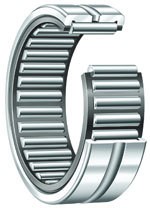
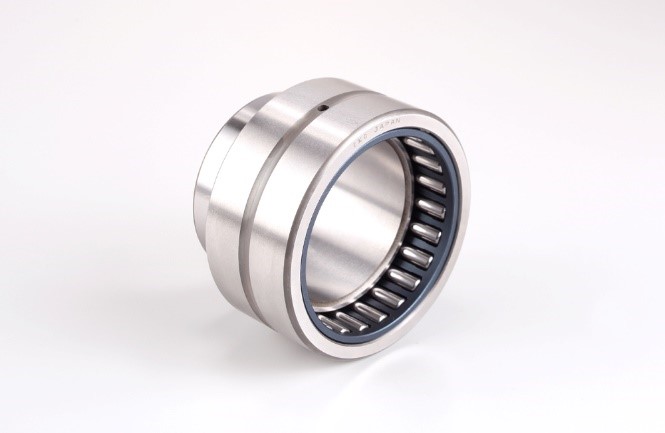
A machined needle roller bearing is a needle bearing with a solid, precisely machined outer ring, and often an inner ring too. It handles heavier load and runs more accurately than a pressed drawn cup type, making it the choice for construction, mining, and heavy industrial machinery.
At Shree Balaji Export, machined needle roller bearings are one of the heavier-duty products we make for customers who cannot afford a bearing to fail mid-shift. Every ring is turned, hardened, and ground on precision machines rather than pressed from sheet metal, and each finished bearing goes through a dimensional and load check before packing. We ship to buyers in Sri Lanka, South Africa, the UAE, Nigeria, Egypt, Indonesia, Thailand, and Kuwait, and our documentation team prepares export paperwork alongside the shipment so customs and logistics stay simple on your end. You can visit Shree Balaji Export to see our full bearing range and request a quotation.
Product Specification
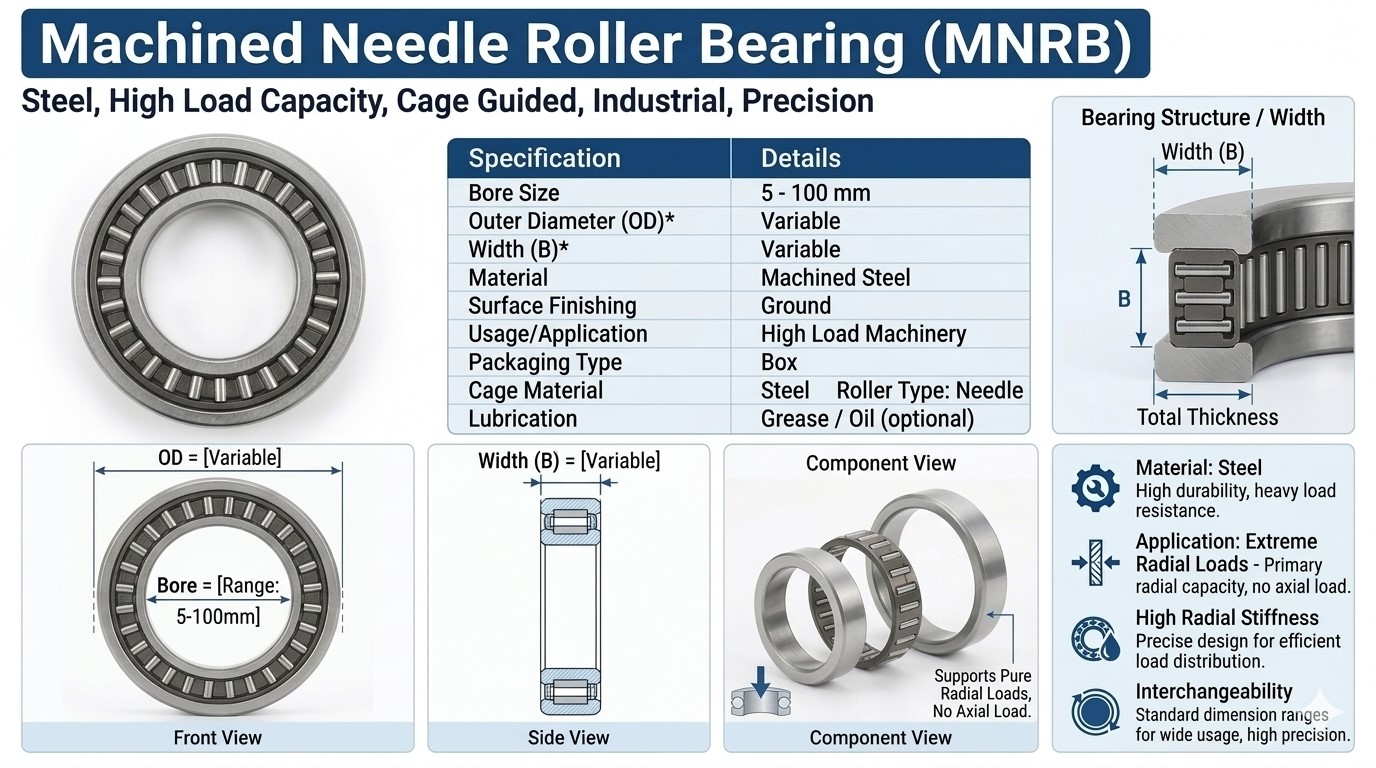
| Material | Steel |
|---|---|
| Bore Size | 5-100 mm |
| Outer Diameter | Variable |
| Width | Variable |
| Roller Type | Needle Cage |
| Cage Material | Steel |
| Lubrication | Grease |
What Is a Machined Needle Roller Bearing?
A machined needle roller bearing is built with a solid outer ring that is turned and ground from a metal blank, unlike the thin pressed shell used in a drawn cup design. This solid ring gives the bearing a rounder, more accurate shape and lets it handle a much heavier load without bending or flexing under pressure.
Many machined needle roller bearings also come with their own inner ring, which means the shaft under the bearing does not always need to be hardened. Other versions leave out the inner ring to save space, in which case the shaft surface must still be hardened and ground, similar to a plain needle roller and cage assembly.
Because the outer ring is machined rather than pressed, this bearing type can be made in much larger sizes and heavier series than a drawn cup bearing. It also holds its shape better under shock load, which is why it is often chosen for construction equipment, mining machinery, and heavy industrial gearboxes rather than small motors or hand tools.
Machined Needle Roller Bearing vs Drawn Cup Needle Roller Bearing: What Is the Difference?
A drawn cup needle roller bearing uses a thin, pressed steel shell, which keeps it compact and low-cost but limits how much load and shock it can take. A machined needle roller bearing uses a solid, turned and ground outer ring, so it costs more to produce but handles heavier load, larger sizes, and rougher working conditions. When a job involves shock load, high precision, or a very large shaft, the machined type is usually the safer choice.
Types of Machined Needle Roller Bearings
These heavy-duty needle bearings are grouped mainly by whether they include an inner ring:
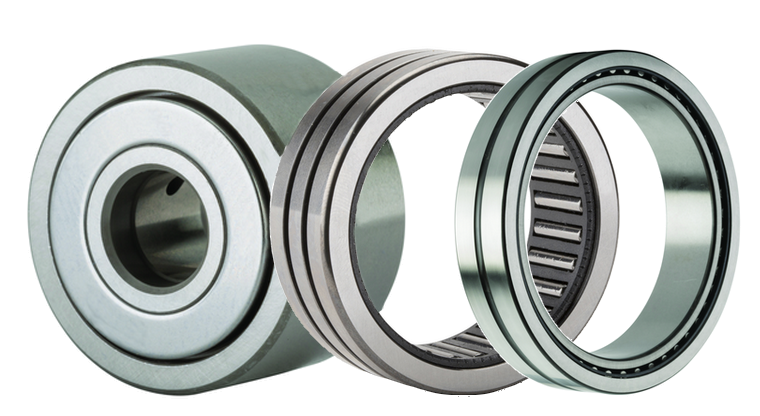
- Machined Needle Roller Bearing with Inner Ring (NA Series): This type includes its own inner ring, so it can be fitted onto a shaft that has not been specially hardened. It is common in construction equipment and general industrial machinery.
- Machined Needle Roller Bearing without Inner Ring (RNA Series): Here the inner ring is left out to save radial space, so the shaft itself must be hardened and ground to act as the raceway. It suits machines where space is tight but load is still high.
- Heavy Series Machined Needle Roller Bearing: This version uses a thicker, stronger outer ring and larger rollers to carry extra heavy load. It is a common choice for mining equipment, crushers, and large gearbox countershafts.
- Combined Machined Needle Roller Bearing: This design pairs the needle roller section with a thrust bearing or ball bearing in one solid unit, so it can carry radial load and axial load together in demanding machinery.
Machined Needle Roller Bearing: Part Numbers, Sizes & Applications
The table below shows common series of machined needle roller bearings, their usual size range, and where each type is generally used. Share your shaft size and expected load with our technical team for an exact match.
| Part Number | Bore (mm) | Outer Dia. (mm) | Width (mm) | Bearing Type | Typical Application |
|---|---|---|---|---|---|
| NA 4906 | 30 | 47 | 17 | Machined Needle Roller Bearing (with inner ring) | Construction equipment hydraulic pump shaft |
| RNA 4913 | 72 | 90 | 22 | Machined Needle Roller Bearing (without inner ring) | Printing press cylinder support |
| NAO 20x37x16 | 20 | 37 | 16 | Machined Needle Roller Bearing (heavy series) | Machine tool gearbox countershaft |
| NA 6905 | 25 | 42 | 23 | Machined Needle Roller Bearing (heavy duty) | Excavator swing gear shaft |
| RNAO 40x55x20 | 40 | 55 | 20 | Machined Needle Roller Bearing (without inner ring) | Heavy pump and compressor shaft |
| NA 4830 | 150 | 190 | 40 | Machined Needle Roller Bearing (large bore) | Rolling mill and crane wheel shaft |
Benefits of Choosing the Right Machined Needle Roller Bearing
- Handles Heavy and Shock Load: The solid machined ring resists bending under sudden or heavy force, keeping tough machinery running.
- Holds Shape Under Pressure: Unlike a thin pressed shell, a machined ring stays round and accurate even after years of hard use.
- Available in Larger Sizes: Machined construction allows bigger bore sizes than drawn cup types, suiting large shafts and heavy equipment.
- Good With or Without Inner Ring: Choosing NA or RNA series gives flexibility for hardened or unhardened shaft setups.
- Strong in Rough Conditions: The solid build stands up well to dust, vibration, and uneven load found on many heavy industrial sites.
- Long Working Life: Precision grinding and heat treatment give a smoother running surface, stretching out the time between replacements.
Machined Needle Roller Bearing Use in Our Export Markets
Every market we serve puts a slightly different demand on a machined needle roller bearing, based on the machinery and working conditions common there. Here is a short country-by-country note on typical use:
| Export Market | How Machined Needle Roller Bearings Help Locally |
|---|---|
| Sri Lanka | Rubber-processing rollers and heavy pump shafts get steady, wear-resistant support even under continuous plantation-line duty. |
| South Africa | Deep-mine hoists and crushing plant gearboxes lean on the solid outer ring for tough, shock-loaded conditions underground. |
| UAE | Large construction cranes and precast concrete plant machinery use these bearings where shaft loads are high and downtime is costly. |
| Nigeria | Oilfield service rigs and heavy earthmoving equipment need a bearing that keeps running despite rough terrain and dust. |
| Egypt | Sugar cane crushers and cement plant rollers depend on the machined ring's rigidity to resist bending under constant pressure. |
| Indonesia | Coal handling conveyors and forestry machinery use these bearings for their strength in wet, high-debris environments. |
| Thailand | Rubber and palm processing plants fit these bearings on heavy roller shafts that see round-the-clock production runs. |
| Kuwait | Petrochemical plant compressors and desalination pump shafts rely on the precise machined bore for smooth, aligned running. |
| Worldwide | Any heavy-duty machine needing a strong, precisely made bearing in a tight radial space can use this bearing type reliably. |
How to Select the Right Machined Needle Roller Bearing
- Estimate Load and Shock Level: Heavier or sudden loads usually call for a heavy series bearing rather than a standard one.
- Decide on Inner Ring Need: Pick the NA series if the shaft cannot be hardened, or the RNA series if radial space must be saved.
- Measure Bore, Outer Diameter, and Width: These three sizes, taken from the shaft and housing, decide the correct series and part number.
- Plan for Heat and Lubrication: Heavy load raises running temperature, so confirm the grease type and greasing interval before final selection.
Common Mistakes to Avoid When Choosing a Machined Needle Roller Bearing
- Picking a Light Series for Heavy Load: Using a standard series where a heavy series is needed leads to early ring or roller damage.
- Skipping Shaft Hardness Checks: An RNA series bearing on a soft shaft will wear out the shaft surface quickly.
- Ignoring Housing Fit Tolerance: A poor fit between the outer ring and housing bore can cause the ring to spin or loosen over time.
- Under-Greasing Heavy-Duty Units: Heavy load bearings need more frequent lubrication checks than light-duty types.
Simple Maintenance Tips for Longer Life
Check the bearing housing for unusual heat or vibration during routine inspection rounds, since these are early warning signs of trouble. Listen for a smooth, steady sound during normal running — a knocking or grinding noise usually means roller or ring damage. Keep to the recommended greasing schedule for heavy-duty use, and inspect the shaft surface whenever an RNA series bearing is removed, since shaft damage can quickly ruin a new bearing.
Get a fast export quote for machined needle roller bearings from Shree Balaji Export — reliable delivery to Sri Lanka, South Africa, UAE, Nigeria, Egypt, Indonesia, Thailand, Kuwait and worldwide.
Frequently Asked Questions
It supports heavy, sometimes shock-loaded shafts in machinery such as construction equipment, mining machines, and large gearboxes.
A machined needle roller bearing has a solid, turned and ground outer ring for heavier loads, while a drawn cup type uses a thin pressed shell suited to lighter, more compact applications.
No. The NA series includes an inner ring, while the RNA series leaves it out to save space. Bearings without an inner ring generally require a suitably hardened and ground shaft raceway.
Yes. Its solid ring construction makes it a good choice for machinery that faces sudden or heavy shock loads, provided the bearing is correctly selected for the load, speed, and operating conditions.
Shree Balaji Export supplies machined needle roller bearings to Sri Lanka, South Africa, the UAE, Nigeria, Egypt, Indonesia, Thailand, Kuwait, and other markets worldwide, with export documentation and delivery arrangements.
Common signs include unusual noise, rising operating temperature, visible pitting on the rollers or ring, and grease that looks dark or contaminated during inspection. These symptoms should be checked to determine whether replacement is necessary.
 Shree Balaji Exports
Specialize in delivering top-quality bearings and related solutions to meet the diverse needs of various industries.