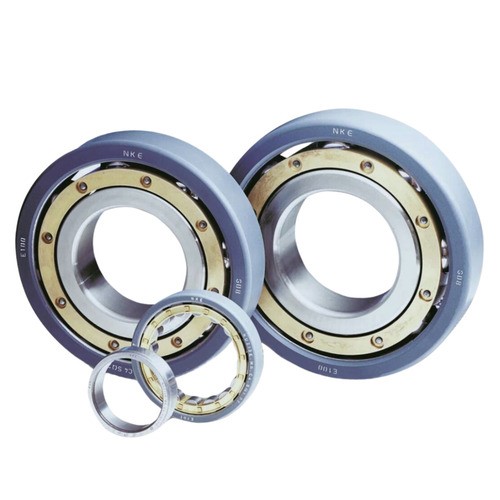
Insulated Bearing helps protect electric motors and machines from electrical current damage while allowing smooth movement. It is commonly used in electric motors, generators, pumps, and other electrical equipment.
Shree Balaji Export is a trusted manufacturer, supplier and exporter of precision-engineered insulated bearings and a comprehensive range of industrial bearing solutions. With deep technical knowledge of electrical bearing failure mechanisms and an extensive product portfolio covering ceramic-coated, hybrid, and nylon-sleeved insulated bearing types, Shree Balaji Export serves customers in Sri Lanka, South Africa, the UAE, Nigeria, Egypt, Indonesia, Thailand, Kuwait, and markets worldwide. Every insulated bearing supplied by the company is sourced from certified manufacturers meeting IEC and ISO performance standards, ensuring that the electrical insulation resistance values and dimensional accuracy required for reliable motor protection are consistently delivered. Whether you are specifying insulated bearings for a new motor installation, retrofitting existing drives to eliminate fluting damage, or building a preventive maintenance programme for a large industrial fleet, Shree Balaji Export provides the product range, technical expertise, and dependable global logistics to support your requirements.
Product Specification
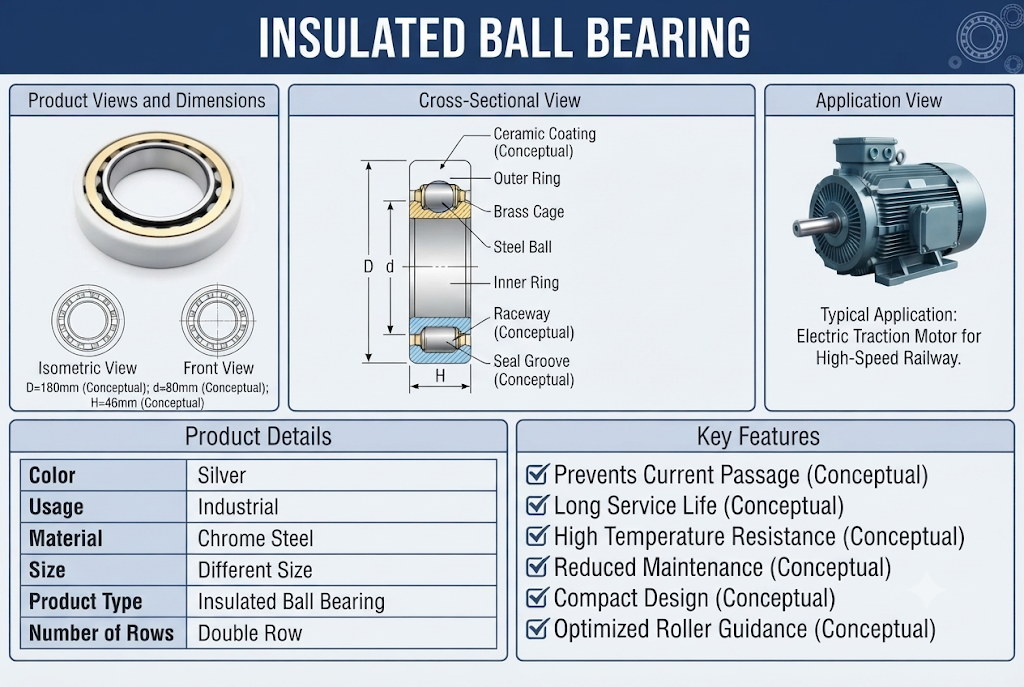
| Color | Silver |
|---|---|
| Usage | Industrial |
| Material | Chrome Steel |
| Size | Different Size |
| Product Type | Insulated Ball Bearing |
| Number Of Rows | Double Row |
What Is an Insulated Bearing?
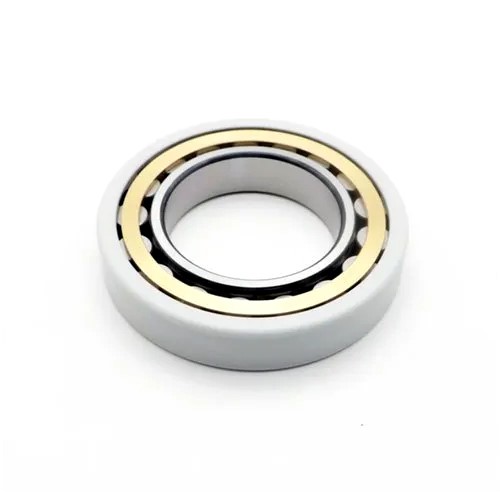
An insulated bearing is a type of bearing that helps protect electric motors from damage. It is a precision rolling element bearing, like a deep groove ball bearing or a cylindrical roller bearing. This bearing has a non-conductive coating or sleeve on its outer ring, inner ring or both. The insulation layer stops stray currents from passing through the bearing. This protects the rolling elements, raceways and machine components from discharge machining (EDM) damage or electric fluting.
Why does this matter? In motors controlled by variable frequency drives (VFDs), high-frequency switching induces voltages on the motor shaft. When this shaft voltage builds up, it discharges through the bearing in an electrical arc. This damages the bearing. Can cause it to fail prematurely. An insulated bearing breaks this discharge path. It prevents any path from forming through the bearing assembly. This is done by coating the ring, inner ring or both with a non-conductive material.
Types of Insulated Bearings and Common Sizes
The insulated bearing market offers types of insulation technologies and bearing configurations. Each type is suited to application requirements.
-
1. Ceramic-Coated Insulated Bearings (Al₂ O₃ Plasma Spray): This type of bearing uses a plasma-sprayed aluminium oxide ceramic coating. The coating is applied to the ring or inner ring. It provides electrical insulation and resistance to corrosion and wear.
2. Hybrid Insulated Bearings (Ceramic Rolling Elements): Hybrid insulated bearings use hardened steel inner and outer rings with silicon nitride ceramic rolling elements. Ceramic is non-conductive, so it interrupts the current path through the bearing.
3. Nylon-Sleeved Insulated Bearings: This type of bearing has a precision-moulded polyamide sleeve that provides electrical insulation and vibration damping. It is a cost-effective solution for medium-duty motor applications.
4. Fully Insulated Bearings (Both Outer Ring Coated): For applications fully insulated bearings are available with ceramic coating applied to both the inner ring bore and the outer ring outside diameter. This provides possible electrical isolation within the bearing assembly.
5. Insulated Cylindrical Roller Bearings: Ceramic-coated insulated bearings of the cylindrical roller type are used in large motor frames. They serve drives in sectors, like mining, cement production and power generation.
Common Sizes and Designation
| Insulated Bearing Type | Typical Bore Range (mm) | Common Designation Suffix |
|---|---|---|
| Ceramic-Coated DGBB (OD) | 25–320 mm | C3VL0241 / INSOCOAT / C3VL2071 |
| Ceramic-Coated Cylindrical Roller | 40–500 mm | C3VL0241 / INSOCOAT |
| Hybrid Ball Bearing (Si₃N₄) | 10–150 mm | HC / HCB prefix or /W77 |
| Nylon-Sleeved DGBB | 12–120 mm | NR / plastic housing variant |
| Fully Insulated (OD + ID Coated) | 50–360 mm | C3VL2071 or dual-coat designations |
Benefits of Using a Quality Insulated Bearing
Fitting the insulated bearing in an application that is vulnerable to electricity delivers a range of significant benefits for how things work and for money that go far beyond just stopping the bearing from failing.
- Complete Elimination of Electrical Fluting Damage: This is the main benefit of an insulated bearing. It physically stops electricity from going through the bearing. This eliminates the sparks that cause damage to the bearing. If you use a specified insulated bearing in a motor that is controlled by a variable frequency drive, the bearing will not fail like this for as long as it is supposed to last.
- Dramatically Extended Bearing Service Life: When electric motors have problems with bearing damage from electricity, the bearing might only last six to eighteen months. But if you put a bearing in the same motor, it can last three to five years or even longer. This means you do not have to replace it as often and you save money on labour.
- Protection of the Entire Drive Train: When electricity is not stopped at the bearing, it can go through the shaft and into the machine that is being driven. This can cause damage to the gearbox, pump and other parts. An insulated bearing on the motor stops this from happening and protects the whole system.
- Reduced Unplanned Downtime: When a bearing fails because of electrical damage it usually happens suddenly and without warning. But if you use a bearing you can stop this from happening and plan when to replace the bearing. This makes things work more smoothly and you can get more work done.
- Insulated bearings are easy to install: coated insulated bearings are the same size as regular bearings. They fit in the space and do not need any changes to the motor or machine. This makes it easy for people who do maintenance to replace the old bearing with a new one.
- Insulated bearings are an investment: an insulated bearing usually costs twenty to forty per cent more than a regular bearing. When you think about all the money you save by not having to replace the bearing as often and by not having to pay for labour and lost production time, it is a good deal. Especially for machines that run all the time.
- Insulated bearings work with systems: as more and more people use variable frequency drives to save energy and automate factories, insulated bearings are becoming a standard part of any motor that is fifteen kilowatts or more and uses a variable frequency drive.
Industry Applications of Insulated Bearings
The insulated bearing is an essential component wherever electric motors or generators operate in conditions that generate bearing currents. Shree Balaji Export serves customers across all of the following sectors from its global supply network:
| Industry Sector | Insulated Bearing Application |
|---|---|
| Electric Motors (VFD-Driven) | All motors 15 kW+ on variable frequency drives — non-drive end bearing standard specification |
| Wind Turbine Generators | Generator drive-end and non-drive-end bearings; gearbox output shaft bearings in onshore and offshore turbines |
| Railway & Mass Transit | Traction motor bearings in locomotives, EMUs, metro trains, and light rail vehicles |
| Industrial Pumps & Compressors | Large centrifugal pump motors, screw compressor drives, multistage pump motors on VFDs |
| Power Generation | Large generator rotor bearing insulation, exciter end bearings, turbine-generator unit bearings |
| Mining & Cement | Large ball mill and kiln drive motors, conveyor belt drive motors, crusher drive bearings |
| Marine Propulsion | Electric propulsion motor bearings, bow thruster motor bearings, shaft generator bearings |
| HVAC & Building Services | Chiller compressor motor bearings, large AHU fan motor drives, cooling tower fan VFD motors |
| Steel & Aluminium Processing | Rolling mill drive motors, continuous casting machine drives, furnace fan motor bearings |
| Water & Wastewater Treatment | Pump motor bearings on VFD control, blower motor bearings, aeration fan drives |
Conclusion
The insulated bearing has become one of the most important preventive maintenance components in modern industrial engineering. As VFD-controlled electric motors proliferate across every sector of global industry — from water treatment plants in Egypt and wind turbine farms in South Africa to manufacturing facilities in Indonesia and railway systems in the UAE — the risk of electrical bearing damage grows with them. The insulated bearing provides a proven, permanent, and cost-effective solution that protects motors, generators, and entire drive systems from one of the most damaging and least visible failure mechanisms in industrial operation. For maintenance managers, procurement engineers, and plant operators who understand the true cost of bearing failure, specifying an insulated bearing is not an optional upgrade — it is essential engineering practice.
Get insulated bearings designed for electrical insulation, industrial equipment, replacement needs, and bulk export orders. Share your requirements and get competitive pricing for worldwide supply.
Frequently Asked Questions
Bearing current damage occurs when stray electrical voltages on a motor shaft discharge through the bearing in microscopic electrical arcs, causing progressive erosion of the ball and raceway surfaces. The primary cause in modern facilities is the use of variable frequency drives (VFDs), whose high-frequency switching generates common-mode voltages that appear on the motor shaft. As VFD usage has expanded rapidly — driven by energy efficiency requirements and process automation — the incidence of electrical bearing damage has grown significantly. Motors with frame sizes above IEC 280 and power ratings above approximately 15 kW are particularly vulnerable. An insulated bearing on the motor non-drive end is now considered best practice for all such motors.
The most reliable diagnostic indicator of electrical discharge damage is the presence of a regular corrugated or washboard pattern on the bearing raceways — a phenomenon called fluting. This pattern is created by thousands of individual discharge events, each removing a tiny amount of material from the same locations on the raceway. In the early stages, fluting may only be visible under magnification; in advanced cases, it is clearly visible to the naked eye. Other indicators include: bearing noise that appears or worsens gradually over months of operation in a VFD-driven motor; unusually grey or dark lubricant inside the bearing (containing metallic particles from EDM erosion); and a pattern of bearing replacements at regular, shorter-than-expected intervals in a motor that has not changed duty. If these signs are present, an insulated bearing replacement should be specified for the next installation.
Standard engineering practice for VFD-driven motors is to install the insulated bearing on the non-drive end (NDE) of the motor, while the drive end (DE) bearing remains a standard bearing. This arrangement creates a circulating current loop break: shaft current can no longer complete a circuit from the drive end through the shaft, through the NDE bearing, and back through the motor frame. For very large motors or those subject to particularly high shaft voltages, insulated bearings may be specified on both ends. It is important not to insulate both ends with insulated bearings without also insulating the motor's external mechanical connections (such as the coupling), or the shaft current will seek an alternative path through the coupled machine's bearings instead.
A quality ceramic-coated insulated bearing should provide an insulation resistance of at least 100 MΩ when measured at 500 V DC or 1,000 V DC — the typical test voltage used in motor service environments. This level of resistance is orders of magnitude higher than the impedance of the current path it is designed to block, ensuring complete and reliable interruption of shaft currents across the bearing's full service life. Nylon-sleeved insulated bearings typically provide 10–50 MΩ, which is sufficient for many medium-duty applications. When sourcing insulated bearings, always request insulation resistance test data or certification from the supplier to confirm the insulation layer's integrity before installation.
After installation, the insulation integrity of an insulated bearing can be verified using a standard insulation resistance tester (megohmmeter) applied between the bearing outer ring (via the motor housing) and the inner ring (via the shaft). A healthy ceramic-coated insulated bearing will show resistance values well above 100 MΩ. A reading below 1 MΩ indicates that the insulation coating may have been compromised — which can happen if the bearing has been incorrectly installed with a conductive grease on the outer ring OD surface, if the housing bore has damaged the coating during fitting, or if the bearing has been fitted into a conductive-lined housing that bridges the insulation. Shree Balaji Export can provide technical guidance on correct installation practices and insulation verification procedures to help ensure your insulated bearings deliver their intended electrical protection throughout their service life.
 Shree Balaji Exports
Specialize in delivering top-quality bearings and related solutions to meet the diverse needs of various industries.