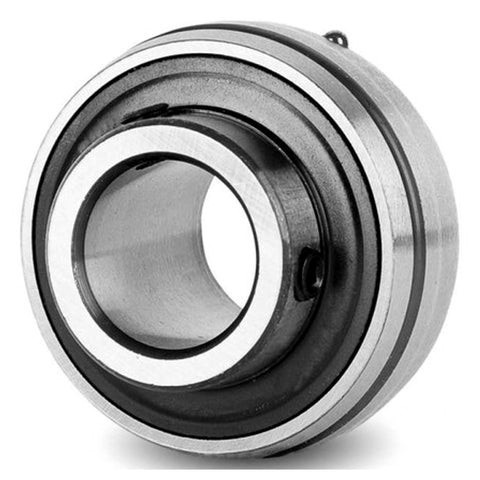
Unit Bearing is a ready-to-use bearing unit that makes installation easier and supports smooth shaft movement. It is commonly used in conveyors, machines, pumps, agricultural equipment, and industrial applications.
Shree Balaji Export is a trusted manufacturer, supplier, and exporter of unit bearings and a comprehensive range of precision bearing products, with active export routes to Sri Lanka, South Africa, the UAE, Nigeria, Egypt, Indonesia, Thailand, Kuwait, and markets worldwide. With deep product knowledge spanning unit bearings across all standard housing styles, accurate OEM cross-referencing, and an export-ready supply chain designed for consistency, Shree Balaji Export is the ideal sourcing partner for businesses that need quality unit bearings delivered reliably to any corner of the globe. Quality, expertise, and global reach — that is the Shree Balaji Export difference.
Product Specification
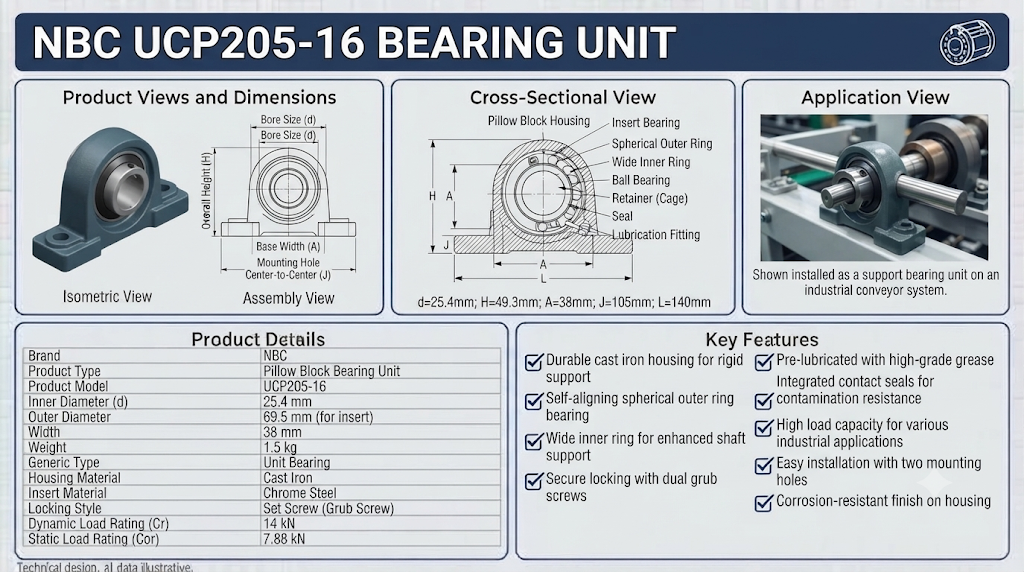
| Brand | NBC |
|---|---|
| Product Type | Bearing |
| Product Model | UCP205-16 |
| Inner Diameter | 25.4 mm |
| Outer Diameter | 69.5 mm |
| Width | 38 mm |
| Weight | 1.5 kg |
| Generic Type | Unit Bearings |
What Is a Unit Bearing?
A unit bearing is a ready-to-install assembly that combines a deep groove ball bearing, housing, seals, and mounting system into one compact unit. It provides smooth rotation, supports radial and axial loads, and simplifies installation and maintenance. Unit bearings are widely used in automotive, industrial, and machinery applications because they offer reliable performance, reduced maintenance, and easy replacement without requiring specialized fitting expertise.
Types of Unit Bearing & Sizes
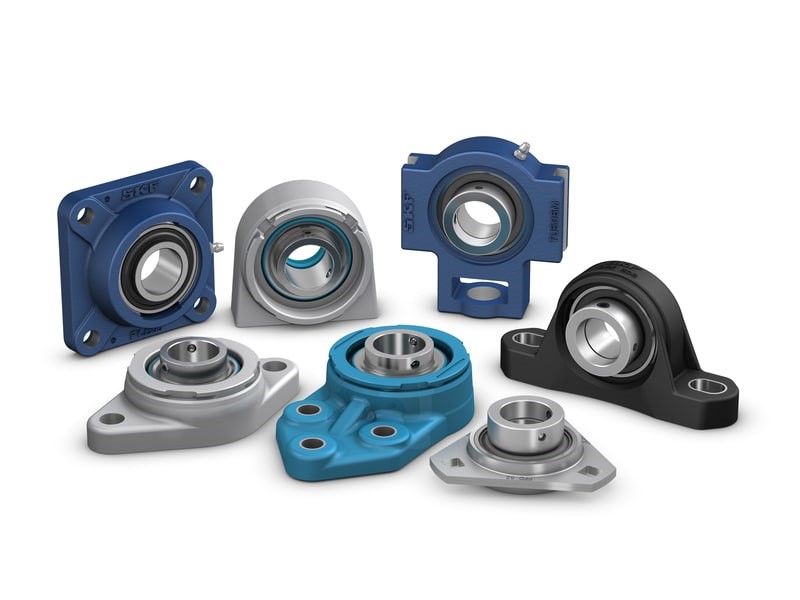
Unit bearings come in a range of housing styles each designed for a specific mounting arrangement and application requirement. All unit bearing types are built around deep groove ball bearings as the internal rolling element, with housing design being the primary differentiator:
1. Singlea) Pillow Block Bearing Units (UCPs — Plummer Blocks)
Pillow Block Bearing Units, also known as Plummer Blocks are the most common and widely recognized unit bearing type. The pillow block houses the bearing within a two-bolt or four-bolt base that mounts directly to a surface below the shaft. The self-aligning capability of the outer ring of the insert bearing within the housing compensates for minor shaft misalignment and mounting surface imperfections. Pillow blocks are used wherever a shaft must be supported from below such as in conveyor systems agricultural machinery drives, fan shafts and general industrial equipment.
- UCP 204 is a unit bearing with a 20 mm bore and a two-bolt base used for duty agricultural and conveyor applications.
- UCP 205 is a unit bearing with a 25 mm bore, used for industrial and agricultural shaft support.
- UCP 206 is a unit bearing with a 30 mm bore, used for -range industrial machinery drives.
- UCP 207 is a unit bearing with a 35 mm bore, used for agricultural and packaging equipment.
- UCP 208 is a unit bearing with a 40 mm bore, used for industrial fan conveyor drives.
- UCP 210 is a unit bearing with a 50 mm bore, used for heavy industrial shaft supports.
- UCP 212 is a unit bearing with a 60 mm bore, used for industrial and construction equipment.
b) Flanged Bearing Units (UCF / UCFL — Two & Four Bolt Flanges)
Flanged Bearing Units are unit bearings that mount to surfaces, walls or machine frames wherever a shaft runs parallel to the mounting surface. Two-bolt flanged units are used where space is limited while four-bolt flanged units offer rigidity for higher-load applications. They are commonly used in wall-mounted fan drives, conveyor end frames, HVAC equipment and packaging machinery.
- UCF 204 UCF 205 and UCF 206 are unit bearings with 20-30 mm bore used for light to medium HVAC applications.
- UCF 207 and UCF 208 are unit bearings with 35-40 mm bore, used for packaging machinery and agricultural equipment fans.
- UCF 210 and UCF 212 are unit bearings with 50-60 mm bore used for heavy fan and blower shaft supports.
- UCFL 204 to UCFL 212 are two-bolt flange variants for space-constrained installations.
c) Take-Up Bearing Units (UCT — Adjustable Centres)
Take-Up Bearing Units are designed with a sliding frame that allows the shaft centre distance to be varied essential for tensioning drive belts or chains in conveyor and drive systems. They are components in conveyor system design across agricultural processing, packaging and mining applications.
UCT 204 to UCT 212 are unit bearings with 20-60 mm bore range, adjustable frame widths to suit system requirements.
d) Cartridge Bearing Units (UCFC / UCPH)
Cartridge Bearing Units are housing units designed to be inserted into a round bore in a machine frame providing a pressed-fit bearing point within the machine structure. They are used in equipment, textile machinery and processing equipment where an external projecting housing is undesirable.
UCFC 204 to UCFC 210 are unit bearings with 20-50 mm bore, used for machinery, textile and processing equipment.
e) Heavy-Duty Plummer Block Units (SNL / SN Series)
Heavy-Duty Plummer Block Units are used for load applications, such as in mining equipment large industrial drives and construction machinery. They have split cast iron or steel housings that house cylindrical roller bearing or spherical roller bearings rather than ball bearings.
SN 505, to SN 520 are unit bearings that accommodate 25-100 mm bore bearings, used for mining, quarrying and heavy industrial drives.
Quick Reference: Unit Bearing Types & Common Bore Sizes
| Unit Type | Housing Style | Bore Size Range | Typical Application |
|---|---|---|---|
| UCP 205 | Pillow Block (2-bolt) | 25 mm | Conveyor / agriculture shaft |
| UCP 208 | Pillow Block (2-bolt) | 40 mm | Industrial fan / drive shaft |
| UCF 206 | Flange (2-bolt) | 30 mm | HVAC / packaging machinery |
| UCF 210 | Flange (4-bolt) | 50 mm | Heavy industrial fan shaft |
| UCT 205 | Take-Up | 25 mm | Conveyor belt tensioning |
| UCFC 207 | Cartridge | 35 mm | Agricultural / textile equipment |
| SN 510 | Heavy Plummer Block | 50 mm | Mining / heavy industrial drive |
Benefits of Using a Quality Unit Bearing
Choosing a high-quality, correctly specified unit bearing from a trusted supplier delivers measurable advantages across every application and industry:
-
1.Simplified Installation and Reduced Labour Cost: Because the bearing, housing, seals, and mounting interface come as a complete, pre-assembled unit, installation requires only mounting to the machine surface and locking the inner ring to the shaft. This dramatically reduces the time, specialist tooling, and risk of error compared to assembling individual bearing components, particularly valuable for maintenance teams operating in the field across remote agricultural or construction sites in Nigeria, Indonesia, or South Africa.
2.Extended Service Life Through Integrated Sealing: Quality unit bearings incorporate contact rubber seals that prevent contamination from dust, moisture, crop debris, and process particles from reaching the internal deep groove ball bearing. This sealing effectiveness is the single most important factor in achieving the full rated bearing life — particularly in the demanding outdoor environments of agricultural and construction applications across tropical and arid export markets.
3.Self-Aligning Capability Compensates for Mounting Imperfections: The spherical outer surface of the insert bearing within most standard unit bearing housings allows angular misalignment of up to 3°–5°. This self-aligning feature protects the bearing from the edge-loading and premature fatigue that rigid bearing arrangements would suffer when mounting surfaces are not perfectly parallel or when shaft deflection occurs under load.
4.Versatile Mounting Options for Every Machine Configuration: With pillow block, flanged, take-up, and cartridge housing variants all using the same insert bearing sizes, a maintenance team can standardise on a single bearing bore size (say 30 mm) and select the appropriate housing style for each mounting point in the machine. This simplifies spare parts inventory management significantly.
5.Reduced Total Maintenance Cost:Quality unit bearings with adequate grease fill and effective seals require minimal attention throughout their service life. For industrial operations in Egypt, Thailand, and the UAE where maintenance resource is premium, the reduced maintenance frequency of quality unit bearings compared to budget alternatives delivers a strong total cost advantage over the service life of the installation.
6.Wide Availability of Standard Sizes: Unit bearings are produced to globally standardised bore sizes (15 mm to 100 mm and beyond) and housing dimensions, making replacement straightforward regardless of the original equipment manufacturer. This universal interchangeability is a significant advantage for export markets where original equipment parts may be difficult or expensive to source.
7.Consistent Performance Across Temperature Extremes: Shree Balaji Export supplies unit bearings pre-packed with high-quality grease rated for wide operating temperature ranges — from the cold nights of South African highveld to the sustained heat of UAE and Kuwait industrial environments — ensuring consistent bearing performance regardless of ambient conditions.
Industry Applications of Unit Bearing
The unit bearing is one of the most universally applied bearing assemblies across global industry. Its combination of simplicity, versatility, and reliability makes it the standard shaft support solution in virtually every sector that uses rotating machinery:
- Agriculture and Food Processing:Across the agricultural heartlands of Indonesia and Thailand, unit bearings are high-volume consumable parts in grain augers, combine harvesters, rice milling machines, irrigation pump drives, and post-harvest processing equipment. Pillow block and flanged unit bearings support the shafts of conveyors, fans, and drive rollers throughout the food production chain. Their sealed, maintenance-friendly design is particularly valued in the dusty, contaminated environments of field and mill operations.
- Industrial Manufacturing and Packaging: Manufacturing and packaging facilities across the UAE, Egypt, and South Africa depend on unit bearings in their production line conveyor systems, filling machine drives, labelling equipment, and packaging machinery. Take-up units keep conveyor belts correctly tensioned; pillow blocks support intermediate shaft positions; flanged units mount fan and blower drives to machine frames. The standardised bore sizing of unit bearings simplifies maintenance across multi-machine production lines.
- Construction and Mining Equipment: Construction equipment operating on sites across Kuwait, Nigeria, and South Africa incorporates unit bearings in conveyor systems for aggregate and ore handling, in portable concrete mixing equipment, and in site hoisting machinery. Mining operations particularly value heavy-duty plummer block unit bearings for large conveyor drives, where the combination of high load capacity, re-lubrication capability, and easy field replacement reduces planned maintenance downtime in continuous production environments.
- HVAC and Building Services: Air handling units, centrifugal fans, cooling tower drives, and industrial ventilation systems throughout the commercial and industrial buildings of the UAE, Kuwait, and Sri Lanka use flanged and pillow block unit bearings to support fan shaft positions. These applications demand bearings that run quietly, require minimal maintenance, and deliver long service life in the continuous-duty operating cycles of building services equipment.
- Automotive and Workshop Equipment: Automotive workshops and vehicle service equipment across Nigeria, Egypt, and South Africa use unit bearings in wheel balancing machines, tyre changers, brake lathes, and workshop conveyor systems. The simplicity of unit bearing replacement — a complete swap of the entire housing assembly — keeps automotive workshop equipment running with minimal technical complexity.
- Domestic and Commercial Water Systems: Pumping stations and water distribution infrastructure across Sri Lanka, Egypt, and Nigeria rely on unit bearings to support the drive shafts of centrifugal pumps in municipal water supply, industrial process water systems, and commercial building water pressure systems. The self-aligning capability of unit bearings is particularly valuable in older pump installations where shaft alignment between motor and pump may have drifted over years of service.
Conclusion
The unit bearing is one of the most practical, versatile, and widely used bearing assemblies in modern industry. By combining a precision deep groove ball bearing with a robust, purpose-designed housing in a single ready-to-install unit, it removes the complexity from bearing maintenance while delivering reliable shaft support across an extraordinary range of applications — from rice mills in Thailand to conveyor drives in South African mines, from HVAC fans in Dubai towers to packaging lines in Egyptian food processing plants.
For procurement professionals, maintenance managers, and parts distributors operating across Asia, Africa, and the Middle East, sourcing unit bearings from a supplier with genuine technical expertise and a reliable international supply chain is fundamental to keeping operations running. The right unit bearing, correctly specified and reliably supplied, is a low-cost investment that protects far more expensive equipment.
Get unit bearings for industrial equipment, machinery, replacement needs, and bulk export orders. Share your bearing requirements with our team and get competitive pricing for worldwide supply.
Frequently Asked Questions
The contact angle of an angular contact ball bearing is the angle between the line connecting the ball contact points on the inner and outer rings, and a plane perpendicular to the bearing axis. In practical terms, it determines the ratio of axial to radial load capacity: a small contact angle (15°) means the bearing handles radial loads more effectively and is optimised for high speed; a large contact angle (40°) increases axial load capacity and rigidity but reduces the maximum operating speed. Selecting the correct contact angle for your application's specific load profile is one of the most important specification decisions when choosing an angular contact ball bearing.
A single row angular contact ball bearing can only react axial forces in one direction — the direction defined by its contact angle geometry. If it is installed alone, any axial load applied in the opposite direction will cause the bearing to open up and become unstable. Installing two bearings in opposite orientations — either back-to-back or face-to-face — creates a system that can handle axial forces from both directions, provides balanced shaft support, and generates the preload necessary to eliminate internal play. Factory-matched pairs are precision-ground to ensure the correct preload is set automatically upon installation.
In a back-to-back (DB) arrangement of angular contact ball bearings, the wide faces of the bearing outer rings face outward and the contact lines converge toward the shaft axis at a point outside the bearing span. This provides maximum moment stiffness — resistance to overturning forces — making it the preferred arrangement for machine tool spindles and precision shafts. In a face-to-face (DF) arrangement, the narrow faces are outward and the contact lines diverge, providing a wider effective bearing span and greater tolerance of shaft and housing misalignment. This is preferred in applications where perfect alignment cannot always be guaranteed, such as agricultural drives and general industrial gearboxes.
In some applications, yes — but only with careful evaluation. An angular contact ball bearing is superior to a deep groove ball bearing when the application involves significant axial loads or requires high shaft rigidity, as its contact geometry is specifically optimised for these conditions. However, a single row angular contact bearing cannot handle bidirectional axial loads alone and requires paired mounting, which may not suit all housing designs. Deep groove ball bearings are simpler to install, handle moderate bidirectional axial loads in a single unit, and are often more cost-effective for applications where pure radial loads dominate. Shree Balaji Export's technical team can assess your specific load conditions and recommend the optimal bearing type.
The angular contact ball bearing market — like all industrial bearing markets — contains a proportion of counterfeit and substandard products that can fail dangerously under load. To ensure you are purchasing certified, quality-grade bearings: (1) Source exclusively from authorised distributors or verified exporters with documented quality credentials; (2) Check that the bearing carries legible, accurate markings on the outer ring confirming brand, designation, and precision class; (3) Verify that the internal clearance or preload designation and contact angle code match your specification; (4) Be cautious of unusually low pricing — quality angular contact ball bearings require precision manufacturing and cannot be produced cheaply without sacrificing performance. Shree Balaji Export sources its bearings from certified manufacturers and is committed to supplying only genuine, quality-verified components to customers across Sri Lanka, South Africa, the UAE, Nigeria, Egypt, Indonesia, Thailand, Kuwait, and worldwide.
 Shree Balaji Exports
Specialize in delivering top-quality bearings and related solutions to meet the diverse needs of various industries.