A tapered roller bearing is a roller bearing with cone-shaped rollers set between two matching tapered raceways. This shape lets it carry radial load (sideways push) and axial load (end-to-end push) at the same time, which is why it is common in wheel hubs, gearboxes, and axles.
Shree Balaji Export manufactures and exports tapered roller bearings and combined-load bearing units to industrial buyers in Sri Lanka, South Africa, the UAE, Nigeria, Egypt, Indonesia, Thailand, and Kuwait. Every bearing is checked for cone and cup finish, roller taper angle, and running clearance before it leaves our factory, and our export team manages packing, paperwork, and shipping so your order reaches you complete and on time.
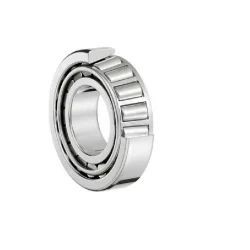
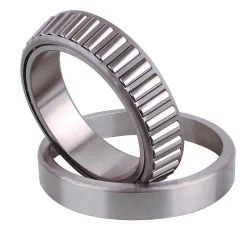
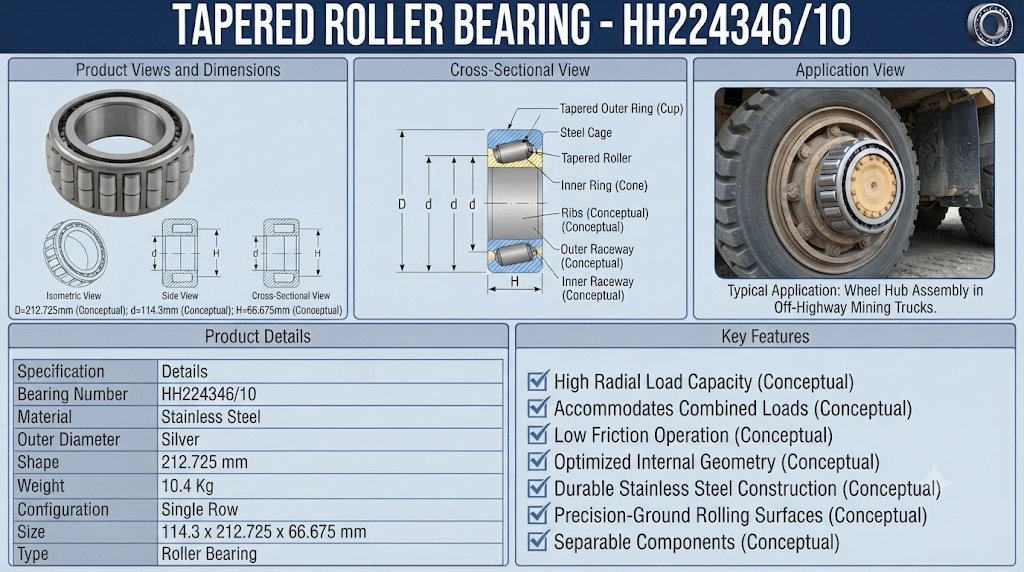
Product Specification
| Bearing Number | HH224346/10 |
|---|---|
| Material | Stainless Steel |
| Color | Silver |
| Outer Diameter | 212.725 mm |
| Shape | Round |
| Weight | 10.4 Kg |
| Configuration | Single Row |
| Size | 114.3x212.725x66.675 mm |
| Type | Roller Bearing |
What Is a Tapered Roller Bearing?
A tapered roller bearing gets its name from its cone-shaped rollers. These rollers sit at an angle between an inner ring, called the cone, and an outer ring, called the cup. Both the rollers and the raceways are tapered, so all the roller surfaces line up with one imaginary point on the shaft centre line. This special shape lets the bearing carry radial load and axial load together, which a plain ball or straight roller bearing usually cannot do as well.
Because of this two-way load ability, tapered roller bearings are widely used where a shaft pushes sideways and along its length at the same time — for example, a car wheel hub, a gearbox shaft with helical gears, or a truck axle. The cone and cup are made as two separate parts, so the bearing can be taken apart for fitting and adjusted for the correct amount of internal play, often called preload or clearance.
Tapered roller bearings are usually fitted in pairs, facing opposite directions. This back-to-back or face-to-face setup lets the pair support axial load from both sides, while sharing the radial load between them. Getting this pair adjustment right is important, since too much play causes wobble, and too little play causes heat and fast wear.
Tapered Roller Bearing vs Ball Bearing: What Is the Difference?
A ball bearing carries mostly radial load and only a small amount of axial load, using round balls that touch the raceway at a point. A tapered roller bearing uses cone-shaped rollers on angled raceways, so it carries strong radial load and strong axial load together. This makes tapered roller bearings the better choice for wheel hubs, differentials, and gearboxes where the shaft pushes in more than one direction at once.
Types of Tapered Roller Bearings
These combined-load roller bearings are grouped by the number of roller rows and the taper angle used:
- Single Row Tapered Roller Bearing: This is the most common type, with one row of cone-shaped rollers between the cone and cup. It handles radial load plus axial load in one direction, and is normally fitted in pairs. It is widely used in wheel hubs, pumps, and gearboxes.
- Steep Angle Tapered Roller Bearing: This version has a larger taper angle, which lets it carry a bigger share of axial load compared to radial load. It suits differential pinion shafts and other spots where end-to-end push is the main concern.
- Double Row Tapered Roller Bearing: Here two rows of rollers are built into one unit, already matched and pre-adjusted at the factory. This saves fitting time and gives strong support for heavy rolling mill housings and large gearboxes.
- Four Row Tapered Roller Bearing (TQ Type): This design packs four rows of rollers into one large bearing, built to carry extremely heavy combined load. It is mainly used in rolling mill roll necks and other very heavy industrial machinery.
Tapered Roller Bearing: Part Numbers, Sizes & Applications
The table below shows common series of tapered roller bearings, their usual size range, and where each type is generally used. Share your shaft size and load direction with our technical team for an exact match.
| Part Number | Bore (mm) | Outer Dia. (mm) | Width (mm) | Bearing Type | Typical Application |
|---|---|---|---|---|---|
| 30204 | 20 | 47 | 15.25 | Single Row Tapered Roller Bearing | Car and light truck wheel hub |
| 32206 | 30 | 62 | 21.25 | Single Row Tapered Roller Bearing | Gearbox input and output shaft |
| 33108 | 40 | 68 | 19 | Single Row Tapered Roller Bearing (steep angle) | Differential pinion shaft, heavy axial load |
| 30310 | 50 | 110 | 29.25 | Single Row Tapered Roller Bearing | Truck axle and trailer hub support |
| 352208 | 40 | 80 | 49.5 | Double Row Tapered Roller Bearing | Rolling mill housing, combined heavy load |
| TQO 380 | 38 | 70 | 51 | Four Row Tapered Roller Bearing (TQ type) | Rolling mill roll neck, extreme heavy load |
Benefits of Choosing the Right Tapered Roller Bearing
- Carries Radial and Axial Load Together: One bearing handles both sideways and end-to-end push, simplifying axle design for fleets in South Africa and Nigeria.
- Strong Under Shock and Uneven Load: The cone-and-cup design stays stable under sudden load changes, useful for rough-road transport in Egypt and Indonesia.
- Adjustable Running Clearance: Fitting the cone and cup as a pair allows fine-tuned play, giving smoother running for machines in Thailand and the UAE.
- Long Life in Wheel and Axle Use: Correct preload and clean lubrication keep hubs and axles running for years, reducing downtime in Sri Lanka and Kuwait.
- Wide Range of Sizes and Angles: Standard and steep-angle series make it easy to match cars, trucks, pumps, and heavy gearboxes.
- Serviceable and Field-Friendly: Separate cone and cup parts make fitting, checking, and replacement easier during routine maintenance.
Where Tapered Roller Bearings Are Used Across Our Export Markets
- Sri Lanka: Tea estate trucks and farm trailer axles use tapered roller bearings to carry combined road and load shock.
- South Africa: Mining haul trucks and conveyor gearbox shafts use tapered roller bearings for heavy combined radial and axial load.
- UAE: Fleet trucks and building service pumps use tapered roller bearings for smooth, reliable wheel and shaft support.
- Nigeria: Commercial vehicle axles and water pump shafts use tapered roller bearings to handle rough road and load conditions.
- Egypt: Irrigation pump gearboxes and farm equipment axles use tapered roller bearings for steady combined-load support.
- Indonesia: Palm oil transport trucks and mill gearboxes use tapered roller bearings to manage heavy shifting load.
- Thailand: Sugar mill rollers and transport trailer axles use tapered roller bearings for dependable heavy-duty running.
- Kuwait: Oil field transport vehicles and pump gearboxes use tapered roller bearings to handle heat, dust, and heavy load.
- Worldwide: Wherever a shaft or axle carries load from more than one direction at once, a tapered roller bearing keeps it running safely.
How to Select the Right Tapered Roller Bearing
- Identify the Load Direction: Check how much of the load is radial and how much is axial, since this decides the taper angle needed.
- Measure Bore, Outer Diameter, and Width: These three sizes, taken from the shaft and housing, are needed to match the correct cone and cup series.
- Plan the Pair Arrangement: Decide on a back-to-back or face-to-face setup based on how the axial load acts on the shaft from both sides.
- Set the Correct Preload: Follow the maker's adjustment steps closely, since wrong clearance is one of the most common causes of early failure.
Common Mistakes to Avoid When Choosing a Tapered Roller Bearing
- Wrong Preload Setting: Too much play causes wobble and noise, while too little play causes heat and fast wear on the rollers.
- Mismatching Cone and Cup: Mixing parts from different series or makers can throw off the taper angle and damage the bearing quickly.
- Ignoring Axial Load Direction: Fitting the bearing pair the wrong way round leaves the shaft unsupported in one direction.
- Poor Sealing in Dirty Conditions: Dust and water entering the cone and cup area quickly damage the roller and raceway surfaces.
Simple Maintenance Tips for Longer Life
Check wheel and axle bearings for play by hand during routine service, since looseness often shows up before any noise is heard. Listen for a steady hum during normal running — a grinding or knocking sound usually means the rollers or raceway are damaged. Keep to the recommended greasing schedule, and always reset the correct preload after any fitting or removal work, since guessing the clearance can shorten bearing life sharply.
Get a fast export quote for tapered roller bearings from Shree Balaji Export — reliable delivery to Sri Lanka, South Africa, UAE, Nigeria, Egypt, Indonesia, Thailand, Kuwait and worldwide.
Frequently Asked Questions
It supports a shaft or axle that carries both sideways and end-to-end load together, such as in wheel hubs, gearboxes, and differentials.
A ball bearing mainly carries radial load with only light axial load, while a tapered roller bearing carries strong radial and axial load together because of its cone-shaped rollers.
A single tapered roller bearing can only support axial load from one direction, so a matched pair is fitted facing opposite ways to support load from both sides.
Yes. Setting the correct running clearance, called preload, is important for smooth running and long bearing life.
Shree Balaji Export supplies tapered roller bearings to Sri Lanka, South Africa, the UAE, Nigeria, Egypt, Indonesia, Thailand, Kuwait, and other markets worldwide, with full export documentation and reliable delivery.
Common signs include noticeable wheel or shaft play, a grinding or knocking noise, uneven roller wear, and grease that looks dark or contaminated during inspection.
 Shree Balaji Exports